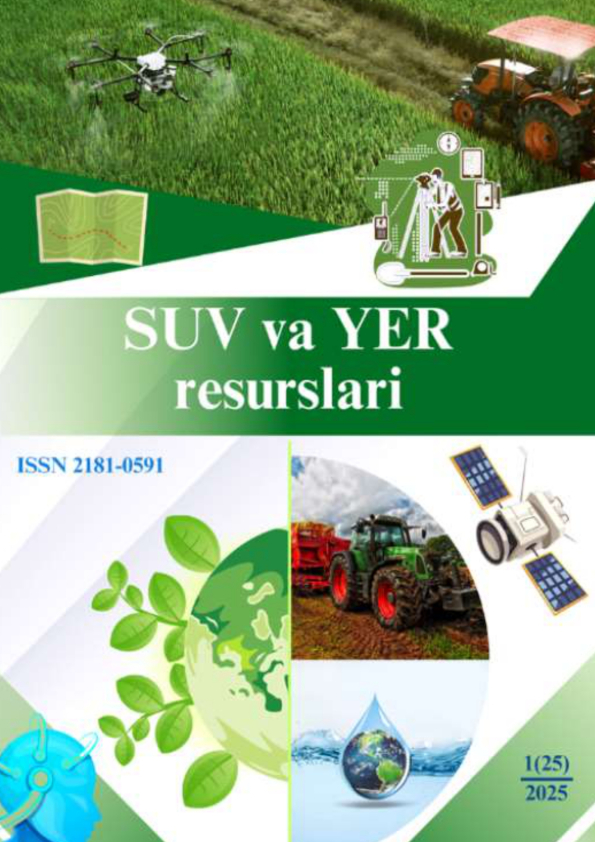
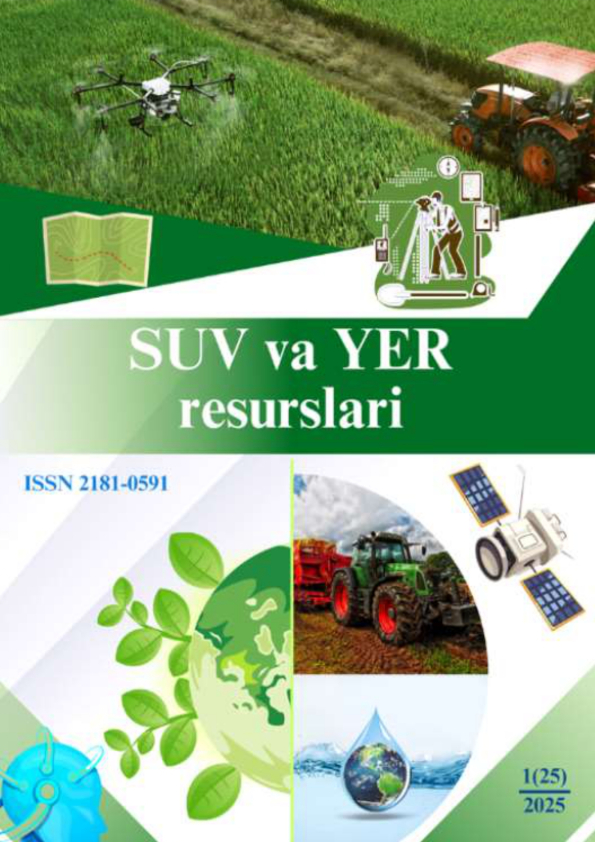
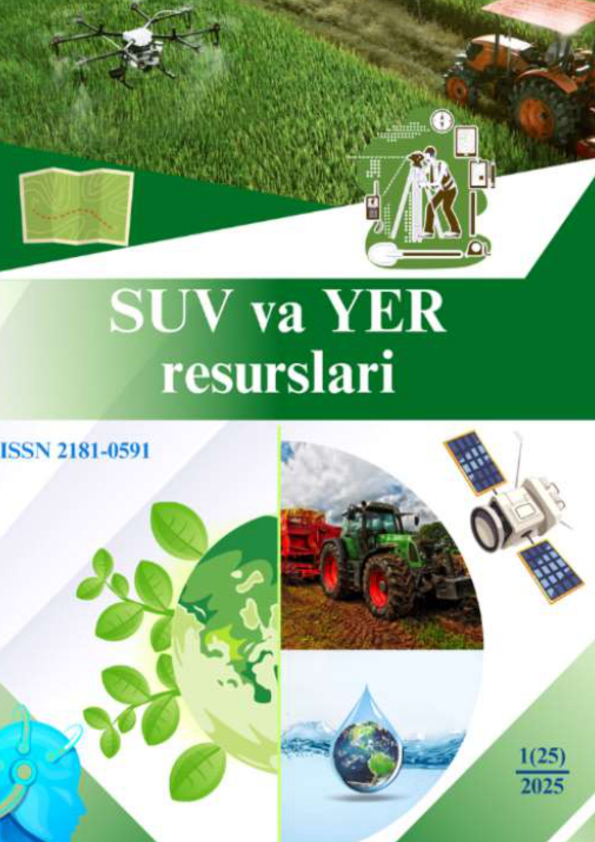
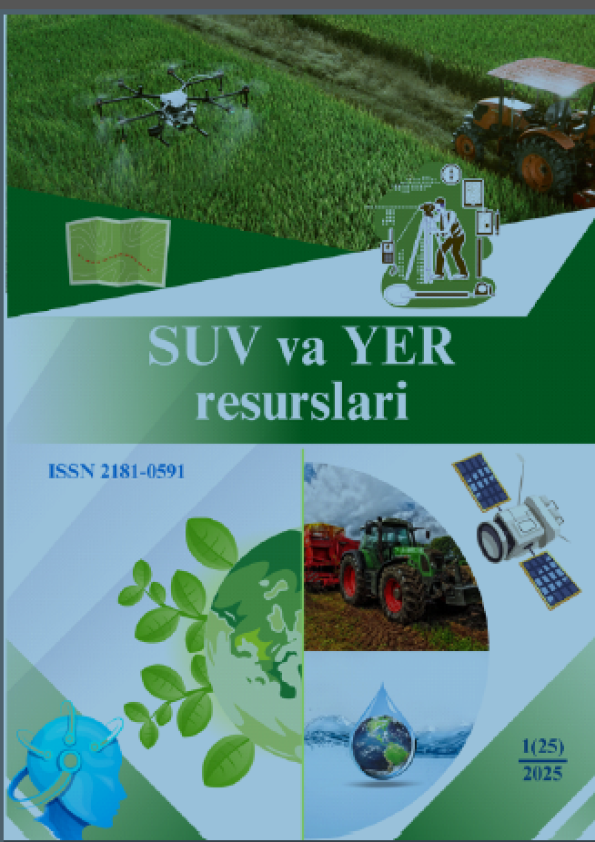
WATER AND LAND RESOURCES
ABOUT JOURNAL
BUKHARA STATE TECHNICAL UNIVERSITY
REQUIREMENTS FOR ARTICLES OF THE “WATER AND LAND RESOURCES” AGRICULTURAL-HYDRO-MELIORATION SCIENTIFIC AND POPULAR JOURNAL
Other rights and privileges of authors are regulated by applicable legislation.
The appropriation of authorship, coercion into co-authorship, and unlawful disclosure of information concerning an industrial property object shall entail liability in accordance with the applicable legislation.
The scientific and technical journal “Water and Land Resources” was registered by the Press and Information Agency of the Republic of Uzbekistan on April 11, 2019 (Certificate No. 05-087).
Founder of the Journal: Ministry of Higher and Secondary Specialized Education of the Republic of Uzbekistan, Bukhara State Technical University.
The scientific and technical journal “Water and Land Resources” is published four times a year, at the end of each quarter. Authors submitting articles for publication shall make the publication payment after the articles have undergone peer review.
Ethics and Copyright
Materials submitted to the Editorial Board must not have been previously published in other publications or be under consideration for publication elsewhere.
Therefore, the author must guarantee, on behalf of himself/herself, all co-authors, and the organization where the work was carried out, that the material submitted to the Editorial Board is intended for publication in this journal.
The author must also guarantee that an article accepted for publication will not be translated into other languages or republished without the written permission of the journal's Editorial Board.
The author also confirms that he/she has read and agrees to the journal's ethical standards and accepts all the responsibilities specified therein.
Topics Covered by the Scientific and Technical Journal “Water and Land Resources”
- mechanization of agriculture and water management, automation and control of technological processes;
- rational use of water resources, improvement of the reclamation status of lands, environmental protection and hydraulic structures;
- power supply of agriculture and water management, and the use of non-conventional energy sources in the sector;
- land-resource management and efficient use of land resources;
- current issues in the training of highly qualified specialists for agriculture and water management;
- reforms being implemented in the fields of irrigation and land reclamation.
The scientific and technical journal “Water and Land Resources” does not accept general review articles or articles of a purely informational nature for publication.
The manuscript submitted to the Editorial Board must be accompanied by a covering letter from the management of the organization where the author conducts scientific research, an expert opinion confirming the possibility of publishing the article, and a peer review.
Language, Structure and Content of the Article
Articles are accepted in Uzbek, Russian, and English.
The article must be written in a language understandable to a broad readership and must comply with grammatical rules.
The article must present completed solutions to a specific scientific research problem or the results of particular stages of such research.
The title must clearly convey the content of the article, be as concise as possible, and not consist merely of general terms.
A scientific article should normally contain the following:
- Universal Decimal Classification (UDC);
- article title (in three languages);
- abstract (in three languages);
- keywords (in three languages);
- introduction, analysis of the current state of the problem under consideration, and references to sources;
- statement of the problem;
- solution method(s);
- analysis of results and examples;
- conclusion;
- list of references;
- information about the author(s).
Generally accepted terminology should be used in the article. When introducing a new term, it must be clearly justified.
Units of measurement of physical quantities must comply with the International System of Units (SI).
Only previously unpublished articles are accepted for publication.
Authors are advised not to excessively cite their own works; the proportion of self-citations should generally not exceed 20–25%. If the number of self-citations exceeds this proportion, the author should provide an appropriate justification.
The Editorial Board takes a negative view of plagiarism and appropriation of the works of others. Therefore, authors are requested to strictly follow citation rules and ensure that bibliographic references are provided in square brackets.
Technical Requirements for the Article
The article title, author(s), position, academic degree, affiliation, abstract, and keywords in three languages must be formatted in one column.
The remaining text of the article must be formatted in two columns.
The article must be prepared using MS Word 2003–2010 and must strictly comply with the following requirements:
- page format — A4;
- page margins — 2 cm;
- font — Times New Roman;
- main text font size — 12 pt;
- table font size — 10 pt;
- line spacing — 1.15;
- text alignment — justified;
- first-line paragraph indentation — 1 cm (without using the “Tab” or “Space” keys);
- article length — at least 8–10 pages.
The following are not permitted:
- page numbering;
- automatic page breaks in the text;
- automatic references in the text;
- automatic hyphenation;
- rarely used or non-standard abbreviations.
Tables must be created using MS Word. The table number and title must be placed above the table.
See Appendix 3.
Graphic materials (color figures, drawings, diagrams, and photographs) must represent generalized research findings.
Graphic materials must be of high quality. If necessary, the Editorial Board may require such materials to be submitted as a separate JPG file with a resolution of not less than 300 dpi.
The caption and sequential number of each graphic material must be placed below the figure.
See Appendix 4.
Formulas and mathematical symbols must be created using the built-in MS Word equation editor or MathType.
See Appendix 2.
Tables and graphic materials must not extend beyond the designated page area.
Keywords
Keywords in Uzbek, Russian, and English must consist of 5–10 words or phrases.
Keywords and phrases must be separated by commas.
The selected keywords must accurately reflect the subject of the research.
Abstract
The abstract in Uzbek, Russian, and English must contain 200–250 words and provide a concise informational description of the structure and content of the article.
When the abstract is translated into another language, its meaning and content must correspond to the original text. The translated abstract may exceed the specified word limit if necessary.
Introduction
The introduction must describe the relevance of the research and characterize the research object.
It must include an analysis of scientific articles published by researchers from different countries.
After demonstrating, based on published literature, that certain scientific issues remain unresolved, the authors must indicate which researchers’ works served as the basis for their study.
The reference list must contain at least 20 sources. Exceptions may be made for difficult-to-access sources, regulatory documents, and Internet sources; periodical documents are excluded from this exception.
Textbooks and teaching manuals must not be included in the reference list.
Most of the sources should be in English and accessible and understandable to an international readership.
Strict requirements are applied to the relevance and significance of the sources.
Statement of the Problem
This section should indicate which official documents the author relied upon in addressing the problems related to the research topic and which specific issues are intended to be solved.
Solution Method(s)
This section must provide a detailed description of the selected research method.
The presented or applied method must be described in a clear manner so that it can be understood and conveniently used by other researchers.
Results and Examples
It is recommended that the results be presented mainly in the form of tables, graphs, and other illustrations.
This section should include an analysis and interpretation of the obtained results, as well as a comparison of the results with those obtained by other authors.
The “Results” section should provide a concise summary of the scientific research findings.
The results should include numerical conclusions summarizing the main scientific findings of the article and the relationships between the parameters of the research object established by the authors.
The results must be logically connected with the objectives stated at the beginning of the article.
Acknowledgement
This section is optional.
Conclusion
The conclusion should present the main findings of the scientific work, including the research method, the new solution proposed, practical application results, economic indicators, and other relevant indicators.
Formatting the List of References
All sources must be cited in the body of the article as numbered references.
References in the text must be placed in square brackets (for example, [1]).
All sources included in the reference list must be cited in the body of the article. Otherwise, the article will be returned to the author.
Information About the Author(s)
The following information must be provided:
- surname;
- first name;
- patronymic/middle name;
- position;
- academic degree;
- place of employment.
This information must be provided in Uzbek, Russian, and English and placed at the end of the article, after the reference list.
2025
10 items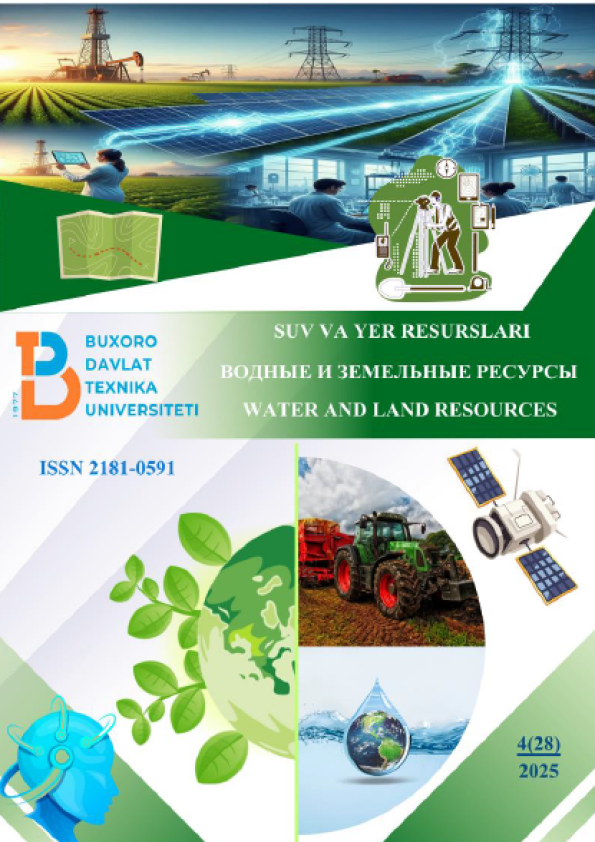
2024
5 items
2023
8 items
2022
9 items
2021
4 items