




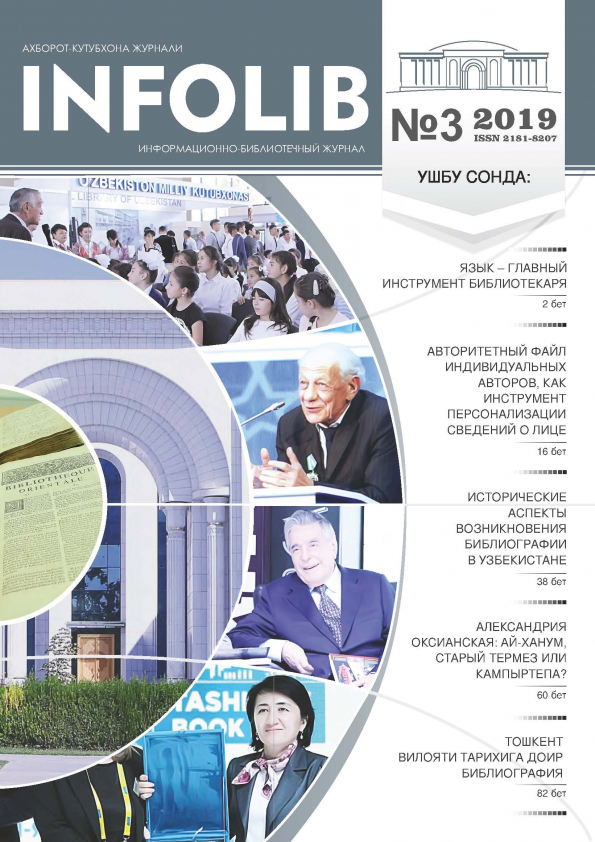
INFOLIB–INFORMATION-LIBRARY JOURNAL OF UZBEKISTAN

SLIB Guide
Author Guide
The editorial office of the journal corresponds with the author responsible for communication; however, upon request of the group of authors, correspondence may be sent to all authors for whom an email address is provided.
Manuscripts and accompanying documents should be submitted to the editorial office via email at fm.info@natlib.uz.
You can review the peer review procedure by following the provided link.
Before publication, the final layout version of the article is sent to the corresponding author for verification. The author must review it and respond within three days. If no response is received within this period, the layout of the article is considered approved for publication.
Procedure for Appealing the Decision of the Editor/Reviewer
If the author disagrees with the conclusion of the reviewer and/or editor, or with specific comments, they may appeal the decision. To do so, the author must:
• revise the manuscript in accordance with the well-founded comments of the reviewers and editors;
• clearly present their position on the matter in question.
The editors support the resubmission of manuscripts that could potentially be accepted but were previously rejected due to the need for substantial revisions or additional data collection. They are also willing to provide detailed explanations of what should be corrected in the manuscript for it to be accepted for publication.
Correction of Errors and Article Retraction
Suppose errors are found in the text of an article that affect its readability but do not distort the presented research results. In that case, they may be corrected by making amendments to the article text.
If errors are discovered that distort the research results, or in cases of plagiarism, or unethical behaviour by the author(s) related to data falsification and/or fabrication, the article may be retracted. The retraction may be initiated by the editorial board, the author, an organisation, or a private individual.
A retracted article is marked with the label “Article Retracted”, and information about the reason for retraction is placed on the article’s webpage. Information about the retraction is also sent to the databases in which the journal is indexed.
Editorial Actions in Cases of Plagiarism, Fabrication, or Falsification of Data
In cases where unethical behaviour by an author is detected—such as plagiarism, fabrication, or falsification of data—the editorial board acts in accordance with the COPE (Committee on Publication Ethics) guidelines.
The journal “INFOLIB” defines unethical behavior as any actions by a researcher that involve improper handling of study objects or deliberate manipulation of scientific information, resulting in distortion of the observed research outcomes, as well as conduct that does not comply with accepted ethical and scientific standards.